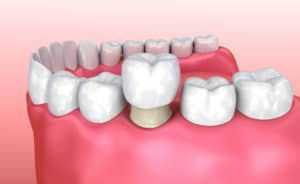
Dental Crowns and Bridges

wilmington dentist

Bridges

Bridges are natural-looking dental appliances that can replace a section of missing teeth. Because they are custom-made, bridges are barely noticeable and can restore the natural contour of teeth as well as the proper bite relationship between upper and lower teeth.

Bridges are sometimes referred to as fixed partial dentures, because they are semi-permanent and are bonded to existing teeth or implants. There are several types of fixed dental bridges (cannot be removed), including conventional fixed bridges, cantilever bridges, and resin-bonded bridges. Unlike a removable bridge, which you can take out and clean, your dentist can only remove a fixed bridge.

Porcelain, gold alloys, or combinations of materials are usually used to make bridge appliances.

Appliances called implant bridges are attached to an area below the gum tissue or the bone.

Crowns

Crowns are synthetic caps, usually made of a material like porcelain, placed on the top of a tooth.

Crowns are typically used to restore a tooth’s function and appearance following a restorative procedure such as a root canal. When decay in a tooth has become so advanced that large portions of the tooth must be removed, crowns are often used to restore the tooth.

Crowns are also used to attach bridges, cover implants, prevent a cracked tooth from becoming worse, or an existing filling is in jeopardy of becoming loose or dislocated. Crowns also serve an aesthetic use, and are applied when a discolored or stained tooth needs to be restored to its natural appearance.

Procedures

A tooth must usually be reduced in size to accommodate a crown. An impression is then made from the existing tooth to create a custom-designed crown. The impression is sent to a special lab, which manufactures a custom-designed crown. In some cases, a temporary crown is applied until the permanent crown is ready. Permanent crowns are cemented in place.

Crowns are sometimes confused with veneers, but they are quite different. Veneers are typically applied only to relatively small areas.

Caring For Your Crowns

With proper care, a good quality crown could last up to eight years or longer. It is very important to floss in the area of the crown to avoid excess plaque or collection of debris around the restoration.

Certain behaviors such as jaw clenching or bruxism (teeth grinding) significantly shorten the life of a crown. Moreover, eating brittle foods, ice, or hard candy can compromise the adhesion of the crown, or even damage the crown.

Dental Crowns & Bridges FAQs – Plage Dentistry, Wilmington, NC

1. What is the difference between a crown and a bridge?

A crown is a custom-made cap placed over a damaged or weakened tooth, while a bridge is used to replace one or more missing teeth by anchoring to neighboring teeth or implants. Crowns can also be used as part of a bridge to support the structure.

2. When would I need a dental crown?

You may need a crown if you have:
A broken, cracked, or worn tooth
A tooth that had a large filling
A tooth that’s had a root canal
A discolored or misshapen tooth
A dental implant or bridge that needs support

3. What are dental bridges used for?

Bridges fill in the gap where teeth are missing, helping to:
Restore chewing and speaking ability
Maintain proper bite alignment
Prevent shifting of surrounding teeth
Enhance smile aesthetics

4. What materials are used for crowns and bridges?

Common materials include:
Porcelain or ceramic (tooth-colored, natural-looking)
Metal alloys (gold or silver-colored, highly durable)
Porcelain-fused-to-metal (PFM) – a blend of strength and appearance
Your dentist will recommend the best option based on the tooth’s location and your preferences.

5. How long do crowns and bridges last?

With proper care, crowns and bridges can last 8–15 years or longer. Their longevity depends on:
Oral hygiene
Bite pressure
Dietary habits
Avoiding habits like teeth grinding or chewing hard foods

6. What’s the procedure like for getting a crown or bridge?

The process usually involves:
Tooth preparation – reshaping the tooth to fit the crown/bridge
Impressions – for a precise custom fit
Temporary crown/bridge – to protect your tooth while your final one is made
Final placement – the crown or bridge is permanently cemented
At Plage Dentistry, we ensure your restoration is comfortable and natural-looking.

7. Do crowns or bridges require special care?

Yes. To keep them in top condition:
Brush and floss daily, especially around the bridge or crown edges
Consider floss threaders or water flossers for under bridges
Avoid chewing hard objects like ice or hard candy
Come in for regular dental checkups and cleanings

8. Can a crown or bridge be repaired if it gets damaged?

Minor damage may be repaired, but in some cases, the restoration may need to be replaced. Contact us promptly if you notice any loosening, discomfort, or visible cracks.

9. Will people be able to tell I have a crown or bridge?

Not at all — modern materials like porcelain and ceramic mimic the look of natural teeth. We custom-match the shape and color so your restoration blends seamlessly with your smile.

10. How much do dental crowns and bridges cost?

Costs vary depending on the material used, the number of teeth involved, and whether implants are part of the treatment. Many insurance plans offer partial coverage. We’ll provide a detailed treatment plan and help verify your benefits.